AI Art · October 12, 2024 · Updated August 26, 2026 · 15 min read · 15439 views
Top 10 AI Diwali Image Prompts for Festival Art

Why generic Diwali AI prompts look the same, and the specific cultural detail and lighting language that makes them feel real.
Diwali Photo Editing
Upload a photo and pick a Diwali style: diyas, rangoli, fireworks and more.
Type "Diwali" into most AI image generators and you get some version of the same picture. A haze of gold particles floating in dark air, a vague temple shaped silhouette, an orange bokeh wash, maybe a hand holding something meant to be a diya that reads more like a candle in a teacup. None of it looks like an actual Diwali. It looks like a model's idea of "festival of lights," which is a phrase, not a description, and the output shows it.
The fix is the same one that works for any subject a model treats as a vague category: get specific about what is actually in the scene. The exact shape of a terracotta diya. What a rangoli pattern is actually made from. Which sweets show up on a festive platter. The difference between a phuljhari sparkler and a chakra ground spinner throwing off circular trails of light. Naming those things instead of reaching for "festive lights everywhere" is what turns a generic AI image into one that actually looks like Diwali. Below are the color and lighting choices that make a warm nighttime scene read as real, eight full prompts to use or adapt, and where AI models reliably get this subject wrong, along with how to fix each one.
Why "festival of lights" is not a prompt
"A beautiful Diwali celebration, festival of lights, diyas, fireworks, colorful, joyful, high quality" is not wrong, it is just empty. Every word in it is a category rather than a description. "Diyas" does not say they are small terracotta clay lamps with a cotton wick and a warm orange flame, so the model defaults to whatever it saw most often under that label, often closer to a plain candle. "Colorful" names no actual color, so the model reaches for an oversaturated rainbow instead of the specific warm palette Diwali actually has. Naming the real objects fixes this: terracotta clay diyas along a step, a marigold garland toran across a doorframe, a rangoli in a symmetrical lotus pattern made of colored rice powder. Real materials give the model something to render, vague festive language gives it nothing but its own average guess.


Color and light before you write a prompt
Diwali scenes are, structurally, almost always the same lighting problem: small, warm point light sources, diyas, string lights, fireworks, surrounded by darkness. Naming that contrast directly is the single biggest lever in any Diwali prompt. A diya's flame sits close to candlelight, warm orange rather than clean white, and pairing that with a background described as underexposed or falling into shadow is what makes the light sources actually stand out.
The palette has real anchors worth naming instead of just "colorful": marigold orange and yellow, deep maroon and red silk, antique brass and gold. These warm tones read as rich against a deep indigo or near black night sky, the same warm against cool contrast that makes golden hour portraits work, except the warmth here comes from small artificial sources instead of the sun.
Composition choices that matter
Point light sources make natural leading lines. A row of diyas along a step or a window ledge pulls the eye through a frame in a way a scattered pile of lights does not. A soft, out of focus diya flame or two in the foreground ahead of a sharper subject adds depth, worth naming directly rather than leaving depth of field to chance.
Rangoli and puja thalis are meant to be seen from directly above, the way a mandala is read as a flat pattern, so describe the camera as overhead and pointing straight down for those, and at eye level for a portrait or wider scene. Rangoli is also deliberately symmetrical, built around a repeated shape circling a center, so stating that directly keeps it from coming out lopsided. For a graphic rather than a photograph, generous negative space around one clear focal object beats piling several ideas into one small frame.
Eight prompts for real Diwali scenes
Use these as written or adjust the details, the saree color, the exact sweets, to match what you want.
1. Home entryway with diyas, rangoli, and a marigold toran
A traditional Indian home entryway decorated for Diwali evening. A row of small terracotta clay diyas with lit cotton wicks and warm flickering flames lining the edge of the front steps. A fresh marigold flower garland toran hung across the doorframe, made of tightly strung orange and yellow marigold heads with mango leaves woven through it. A rangoli on the ground in front of the door, made of colored rice powder in a symmetrical eight petal lotus pattern in magenta, yellow, and white, with a small ring of diyas around its outer edge. Brass lanterns on either side of the door, warm amber string lights along the roofline, deep blue evening sky in the background. The diyas and lanterns providing most of the light rather than any overhead lighting. Camera at eye level, shallow depth of field with the rangoli in sharp focus.
Naming real materials, terracotta, rice powder, marigold, mango leaves, is what gives this texture instead of a generic decorated doorway.
2. A family gathering lit mostly by diyas
Three generations of an Indian family sitting together on the living room floor on Diwali evening. Grandmother in a maroon silk saree with a gold zari border, mother in an emerald green anarkali suit, father in a navy kurta pajama, two children in matching yellow and red festive clothes. Everyone arranging small clay diyas together on a brass thali on a low wooden table, which also holds a plate of sweets and a dish of rangoli colors. Warm string lights along the wall behind them, room lit mainly by the diyas and a couple of table lamps rather than overhead lights. Genuine mid laugh expressions rather than posed smiles, one child reaching for a sweet. Shot on a 35mm lens, shallow depth of field with the family sharp and the string lights blurred behind them.
Naming actual clothing pieces beats "festive traditional clothing," and describing the diyas as the light source keeps the scene from looking flatly lit.
3. A traditional festive portrait
Portrait of a young woman in a red and gold silk saree with a wide zari embroidered border, hair adorned with a strand of jasmine flowers, wearing gold jhumka earrings and a small maang tikka. Standing near a wall lined with lit diyas, one hand cupped gently around the base of a single lit clay diya at chest height, fingers wrapped naturally around it, thumb resting along the front rim, wrist relaxed, only that one hand in frame. The diya's warm glow lighting her face from below and in front, soft golden hour light supplementing from one side. Out of focus marigold garlands in the background. 85mm lens at f 2, natural visible skin texture warmed by the diya light, gaze looking slightly past the camera, calm expression.
The hand description is deliberately specific, since a hand holding a small object at close range is exactly where models tend to add an extra finger.
4. A sweets platter, shot from directly above
Overhead flat lay of a Diwali sweets platter on a brass thali. Diamond shaped kaju katli with a thin edible silver leaf on top, round motichoor ladoo with a glistening sugar syrup sheen, square pista barfi cut in a checkerboard pattern with chopped pistachio on top, a small stack of orange jalebi coiled and glistening with syrup, a few roasted almonds and cashews scattered around the edge. The thali resting on a red and gold silk cloth, a few marigold petals near the frame edge. One lit diya just outside the frame casting warm directional light across the sweets from the left. Camera directly overhead pointing straight down, soft shadows, front row of sweets sharp and the back row slightly softer.
Naming each sweet by its real name and shape gives the model actual forms to render instead of a vague pile of "Indian sweets."
5. Fireworks over a lit up neighborhood
Wide shot of a nighttime sky over an Indian neighborhood during Diwali. A phuljhari sparkler shower in the foreground, held by a hand at the bottom edge of the frame. An anaar ground fountain firework spraying gold sparks upward from a rooftop in the middle distance. A chakra spinning wheel firework mid spin on the ground to one side, throwing off circular trails of light. Strings of warm fairy lights outlining the rooflines below, a few lit diyas visible on balcony ledges. Deep indigo night sky fading to a warm orange glow near the rooftops from the firework light, long exposure style motion trails on the fireworks. Buildings underexposed and partly silhouetted against the brighter light, camera at a slightly elevated angle looking across the neighborhood.
Naming the actual firework types keeps this from looking like a generic Fourth of July show dropped into an Indian setting.
6. A respectful home puja scene
A woman in a cream and gold silk saree performing a home Lakshmi puja, kneeling in front of a low wooden altar table covered in a red cloth. A small brass idol of Ganesha to one side of the altar as a background object rather than the focal point. A decorated silver puja thali in front of her holding a lit diya, a stick of incense with a thin trail of smoke, small bowls of turmeric and vermilion powder, a small bell near her hand, marigold flowers scattered across the altar cloth, a plate of fruit offerings to one side. Her hands folded together in prayer, eyes closed. Soft warm light from the diya and a couple of candles lighting her face from below, dim ambient room light elsewhere. Camera slightly to the side and at eye level rather than facing the altar directly.
The respectful choice is where the focus sits: the person and the ritual objects as the subject, and any depicted idol kept small and clearly a background object rather than the main subject.
7. A modern minimalist Diwali greeting card
A modern minimalist Diwali greeting card design, flat illustration style. A single centered terracotta diya rendered as simple geometric shapes with a small stylized flame. Warm gradient background transitioning from deep maroon at the edges to warm amber near the center behind the diya. A thin gold line border framing the card. A few scattered marigold petal shapes as flat silhouettes in the lower corner. Hindi text in Devanagari script reading Shubh Deepavali in a clean gold serif style, centered below the diya illustration. Generous negative space around the main elements. No photographic texture, a clean flat vector art look suitable for a social post or a printed card.
This is the one scene here where on image lettering matters, so it is worth picking a model that actually renders Devanagari script, more on that below.
8. Close up hands cupping a lit diya
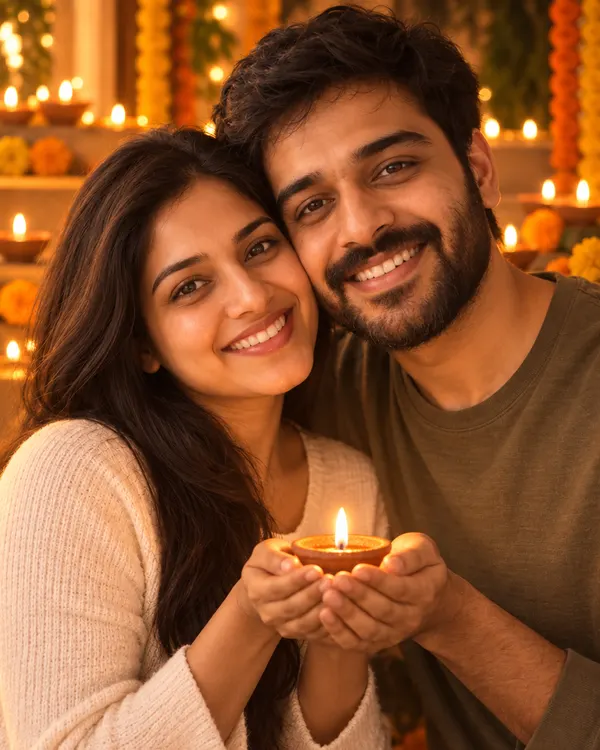
Extreme close up of two cupped hands holding a single lit terracotta diya. Natural skin tone with visible texture, a faint henna pattern along the back of one hand. Fingers wrapped fully around the base of the diya, thumbs resting along the front rim, both hands entering the frame only from the bottom edge, wrist and forearm partially visible and no other body parts in frame. The flame lighting the underside of the fingers with a warm orange glow. Shallow depth of field, the flame and fingertips sharp, background falling into soft dark bokeh with a few blurred string lights behind. Skin catching a warm highlight from the flame with soft shadow in the finger creases.
Same logic as the portrait prompt, at even closer range. Stating exactly how many hands are in frame and how the fingers sit closes off most of the guesswork.
What AI still gets wrong with Diwali scenes, and the fix
Garbled Devanagari or Hindi lettering. Most models train overwhelmingly on Latin script captions, so Devanagari often comes out as decorative nonsense rather than legible characters. Leave text out of a prompt unless a scene truly needs it, and use a model built to render Hindi text if it does.
Extra fingers or a broken wrist around the diya. Hands at close range are one of the hardest things for any model to render, and a diya held in one or both hands shows up constantly here. State exactly how many hands are in frame, describe the grip directly, and keep the rest of the pose simple.
Rangoli that looks melted, blurry, or asymmetrical. This usually means the prompt asked for "intricate" without stating that the pattern needs to be symmetrical and evenly repeated around a center. Naming an actual shape and stating the symmetry directly works better than adding more adjectives.
Marigold garlands that look like a plastic braid instead of individual flowers. This happens when a prompt just says "flower garland" without naming the flower. Naming marigold specifically, and describing individual heads strung closely together, gives the model an actual flower to render.
Fireworks that look like a generic Fourth of July show. A prompt that just says "fireworks" defaults to the common Western style in most training data. Naming the actual types, phuljhari, anaar, chakra, pulls the result toward something that actually looks like Diwali.
A puja scene where a directly depicted deity looks strange or inconsistent. Asking a model to generate a specific worshipped deity's face as the main subject tends to produce odd, inconsistent results. Keeping the person performing the puja as the focal point, and any idol as a small background object, produces a more consistent and respectful result.
If most of a generation is right but one detail is off, a stray extra finger, a garbled word, a rangoli petal that broke the pattern, it is rarely worth starting over. Upload the image to the image to image tool and describe only the fix you need.
Which Enhance AI models actually handle this well
Diwali scenes ask a lot at once: warm, low light conditions, fine ornamental detail in jewelry and embroidery, and sometimes on image text. GPT Image 2 and Nano Banana 2 are the strongest starting points for most prompts above, since both handle warm lighting and decorative detail well. Reach for GPT Image 2 specifically for lettering, since it renders on screen text, including Devanagari, more reliably than most models.
For the minimalist greeting card, Recraft V4 outputs a genuine scalable vector file rather than a raster image styled to look like one. Seedream and Qwen Image are also solid for the photographic scenes, worth comparing since rendering quality varies model to model. The Flux family can produce strong results too and is worth trying as an additional option, though it is not the first pick for lettering.
Enhance AI hosts more than 250 models in total. New accounts get free credits on signup with no card required, and paid access runs on one time payments starting at nineteen dollars rather than a subscription.
A quick checklist before you generate
- Named actual objects, terracotta diyas, marigold garlands, rice powder rangoli, instead of a vague "festive decorations" instruction
- Described the light source directly, warm diya glow against an underexposed background, instead of even, bright lighting
- Named real colors, marigold orange, deep maroon silk, antique brass, instead of just "colorful"
- Stated the camera angle clearly, overhead for a rangoli or thali, eye level for a portrait or scene
- Described any hand holding a diya explicitly, how many hands, where the fingers sit
- Left on image text out of the prompt unless genuinely needed, and picked a model built to render it if so
- Kept a puja scene focused on the person and the ritual objects, not a directly depicted deity
FAQ
Why does the Hindi or Devanagari text on my Diwali graphic come out as garbled nonsense letters?
Most models train mostly on Latin script captions, so Devanagari often renders as decorative shapes, not real characters. It is a training data limitation, not a wording problem. Use a model built to render it, GPT Image 2 handles Hindi text noticeably better than most.
My AI generated hand holding a diya has too many fingers, or the wrist looks broken. What do I do?
State the grip explicitly in the prompt, how many hands, where the fingers wrap, where the thumb sits. If a generation is close but the hand is off, upload it to the image to image tool and describe only the correction needed.
Is it okay to generate images of Lakshmi or Ganesh with AI?
Treat it carefully rather than assuming any result is fine. Keeping the person performing the puja as the subject, and any idol in frame as a small, still background object rather than the main subject, produces a more respectful and coherent result.
What is the best model on Enhance AI for a warm, diya lit indoor scene?
GPT Image 2 and Nano Banana 2 are the strongest starting points. Lean toward GPT Image 2 for real text. Seedream and Qwen Image are worth comparing, and Recraft V4 is the pick for a true vector greeting card file.
Do I need a paid plan to try these prompts?
No. New accounts get free credits on signup with no card required, enough to test several prompts across a couple of models. Continuing past that runs on one time payments starting at nineteen dollars, not a monthly subscription.
Diwali imagery rewards specificity more than most subjects, because the visual tradition is already this detailed, down to the exact shape of a diya and the difference between one firework and another. Start from one of the prompts above, adjust what matters to your own scene, and compare it across a couple of models at Enhance AI before settling on a final image.

Written by Avisek
Avisek covers AI video generation and the creative workflows around it on Enhance AI, comparing tools and models by actually producing clips with them rather than repeating spec sheets.
Related Articles
All Articles


Ready to Create with AI?
Transform your ideas into stunning visuals with Enhance AI. Image generation, video creation, upscaling, and more.